Oct 19 2015, “Canadian Values” victory-day: inclusion over exclusion!

federal-leaders-620

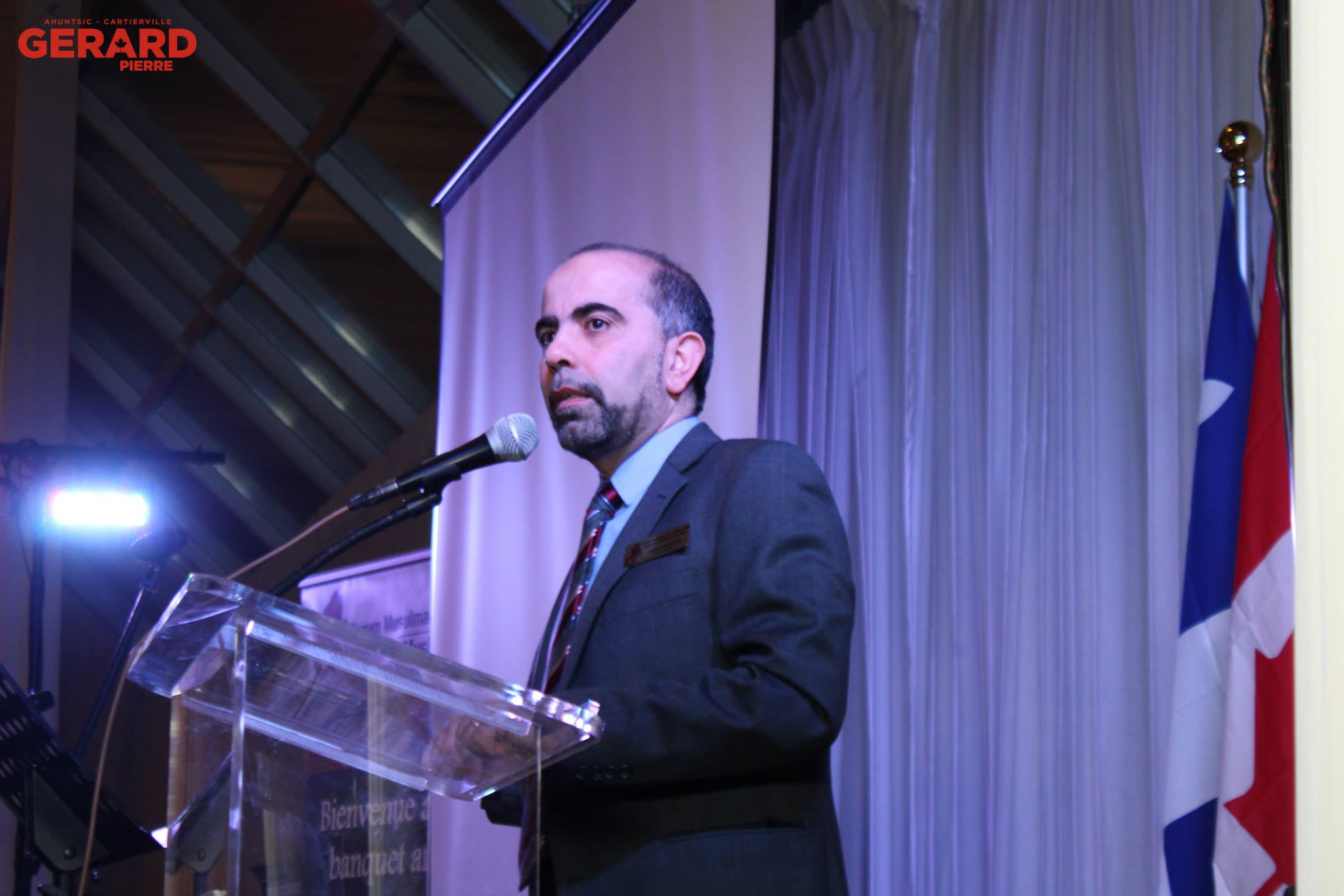
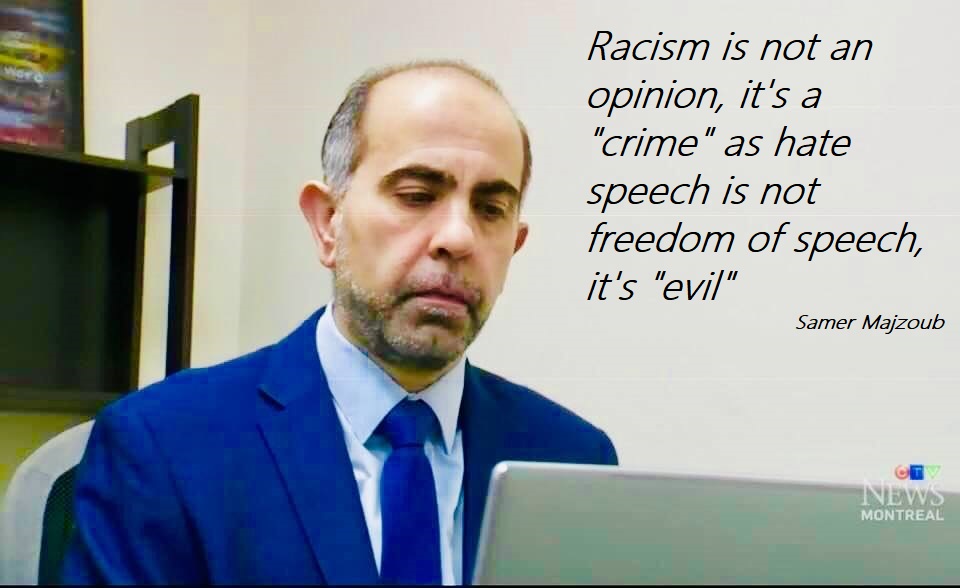
Samer Majzoub, Recipient of Queen Elizabeth II Diamond Jubilee Medal ; President of Human right’s advocacy group ; Recipient of many recognition awards.

The call for the 42nd Federal Canadian  election was issued by the Governor General David Johnston on   August 4. The subsequent campaign spanned 78 days from the dissolution of Parliament to the election, one of the longest campaigns in Canadian history. This was also the first time since the 1930 election when a Canadian Prime Minister tried to win a 4th consecutive term in power.

The main parties’ standings at dissolution of the 41st Parliament was 159 seats for the Conservatives, 95 for the NDP, 36 for the Liberals and 2 for the BQ. From the early stages of the election campaign, it was clear that it would be a hard-fought election due to what was considered a 3-way race between the three main federal parties, CPC, PLC and NDP.  The NDP, being a front-runner, gave this particular election more enthusiasm as historically the Conservatives and Liberals have always ruled the country.

As the elections campaign persisted, polls were clearly showing that Canadians wanted change after almost a decade of Conservatives rule. In spite of the conservatives’ extensive elections media campaign presenting Mr. Stephan Harper as the best leader for the country, by early September, surveys of Canadians had shown the contrary: they were looking for a new PM. All indications were obviously directing towards a new resident at 24 Sussex Drive  in Ottawa, the nations’ capital, on Oct 19.

The three main competing parties, CPC, PLC and the NDP put up strong media campaigns targeting voters with their political platforms. The parties’ leaders wasted no time to present their arguments and points of views over various subjects and topics. This continued until Sept 15 when a Federal Court of Appeal panel dismissed a government appeal over a ban on face coverings at citizenship ceremonies in what amounts to a major policy rebuke of the Harper government. At this point, the election campaign witnessed a sharp spin towards what has been considered by many as ugly and horrible conducts by the Conservatives adopting a very divisive approach and rhetoric in hopes of winning the election.

The Conservative era in the last decade has been overshadowed by controversial policies in many aspects, but mainly by human rights violations under security excuses. The Conservative government ended its ruling period with the very contentious bill C51 and bill C24. Both bills have been considered “ as an attack on constitutional freedoms and an “extraordinary inversion” of the role of judges”  and  “a two-tiered system in which naturalized Canadians are treated as second-class”     .

The election rhetoric based on fear-mongering against women who wear the niqab took over air waves, campaigns, interviews and polls. The campaign turned women’s safety and rights into a political game that distracts from the realities and significant concerns of Canadians. Muslims and Arabs have been problematized as not only a security problem, but as a socio-cultural problem in Canada. The Conservatives thinking they will win more votes from the niqab controversy, sank deeper into their conflict-ridden political campaigns. What made such negative policy bitter is the fact it was run by the prime minister of the country whose main role is to unite Canadians and protect women’s rights.

Muslim Canadians felt and without prior notice that they have been used as a political football for election purposes. The majority of Canadians started to believe that the Muslim community is being used to capitalize on misconceptions and to create fear in the hearts and minds of fellow citizens. As a result, in the midst of the elections movement the xenophobic and Islamophobic sentiments hit a peak and the expected constructive political debates during campaigns turned to be theaters where Islamophobia became a free-for-all scene.

As the election campaign came to its last session, it became clear that the niqab debate that was initiated to the advantage of the Conservatives had back fired.  Mr. Harper relied on polls he ordered himself and bet big time on the niqab debate and lost. Canada is a great country by all means. It can’t accept bigotry, hatred and discrimination. Canadians, on Oct 19 2015, made it clear and loud: yes to inclusion no to exclusion.  The majority of Canadians chose the Federal political parties that have championed Canadian values of unity, harmony, equality and freedom of choice to represent them in the House of Commons. The election results will send a strong message to those politicians who have pursued campaigns of hate, prejudice, Islamophobia, fear and division amongst Canadians that they have harvested what they have planted, loss and defeat.

Samer Majzoub is president of the Canadian Muslim Forum (FMC-CMF).

Samer Majzoub on : Quebec town rezones religious space; Muslim groups hint at discrimination. Sep 3 2015

Eglise Catholique on Lorne Ave in St Lambert. An Anglican church is also located on the street.  New municipal rules would limit space for new religous buildings and activities to existing spots. Another relgion could either buy a church or rent space in one says the mayor.

Eglise Catholique on Lorne Ave in St Lambert. An Anglican church is also located on the street. New municipal rules would limit space for new religous buildings and activities to existing spots. Another relgion could either buy a church or rent space in one says the mayor.
Photo Credit: google street view

Quebec town rezones religious space.

FacebookTwitterGoogle+PinterestEmailPrint

Muslim groups hint at discrimination

The small city of St Lambert, directly across from Montral, has proposed new zoning regulations that affect potential future religious activity in the city.

The new regulations reduce the number of areas available for religious activities from 16 down to nine.  All but one of the zones are already occupied.

The new regulations also redefine “community centres” to exclude religious activities.

The city of St Lambert, directly across from Montreal is proposing to restrict where new religious centres and activities can take place
The city of St Lambert, directly across from Montreal is proposing to restrict where new religious centres and activities can take place © google mm

The new regulations would make it difficult for non-Christian religions to set up a place of worship in the municipality by making it illegal to set up a place of worship outside the current specific zones, mostly already occupied by Christian churches.

The Mayor says the purpose is to protect business areas meant for business.

Three commercial areas are affected by the proposal as well as areas zoned for public or semi-public activities. The public areas covered include city hall, the  public works building, and schools.

Mayor Alain Dépatie is quoted in the Montreal Gazette newspaper saying, ““We wouldn’t want the city hall to be a synagogue or even a Christian church. It’s a non-denominational (building). Same thing for the public works building,” he said. “We’re not saying that we don’t want any, we’re just saying that those areas are for schools and municipal buildings and things like that. Many of the (areas zoned for public works) are those buildings.”

But Samer Majzoub, the head of the Canadian Muslim Forum, is concerned there may be more to it than that.  Quoted by CBC he says, “I am afraid to say that it might be easily considered discriminatory, targeting a group of citizens in a city because of their cultural background, depriving them of their rights to have a cultural community because they don’t like their culture.”

Samer Majzoub, the head of the Canadian Muslim Forum-
Samer Majzoub, the head of the Canadian Muslim Forum- “It might easily be considered discriminatory” Mayor Despated syas it’s to ensure business areas are for business, and public buildings remain secular © CBC

Mayor Dépatie says the purpose is to ensure commercial areas remain for commercial activities, noting for example that the town also moved insurance brokers off the ground level a few years ago to encourage more activity.

He said if another religion wanted to set up a religious centre they could buy a church or rent space from one.

The proposed changes must be put to a public consultation, to be held next week, before they can be adopted.

FacebookTwitterGoogle+PinterestEmailPrint

http://www.rcinet.ca/en/2015/09/03/quebec-town-rezones-religious-space/

These two Quebec Bills Are Apparently Targeting Muslims

Quebec Premier Philippe Couillard takes part in the closing press conference following Canada's Premiers meeting in Ottawa on Friday, January 30, 2015. THE CANADIAN PRESS IMAGES/Sean Kilpatrick

Quebec Premier Philippe Couillard takes part in the closing press conference following Canada’s Premiers meeting in Ottawa on Friday, January 30, 2015. THE CANADIAN PRESS IMAGES/Sean Kilpatrick

By Samer Majzoub:

http://www.huffingtonpost.ca/samer-majzoub/quebec-muslims-hate-crimes_b_7621612.html

Recently, the Quebec provincial government tabled two long-awaited bills to the National Assembly.

Bill 62, on religious neutrality, proposes a number of measures that must be taken into account when considering whether to grant an accommodation on religious grounds and, provides that public services must be both delivered and received by persons with their faces uncovered.

Bill 59, proposes the prohibition of hate speech and speech inciting violence that is engaged in or disseminated publicly that targets people sharing a common characteristic identified as prohibited grounds for discrimination in the Quebec Charter of human rights and freedoms.

The Liberal provincial government has aimed to address very controversial subjects that have been dominating Quebec politics for some time, including reasonable accommodation, youth “radicalization,” and increasing incidents of hate speech. Both bills, 62 and 59, include vast measures and action plans. Topics covered in the two bills are so numerous that it appears as if PLQ, the governing Liberals, are aiming to tackle all divisive issues within Quebec society.

In the last few months, about two dozen Quebec youth have been reported to have left or attempted to leave to war zones in the Middle East. Those reports have raised concerns of what has been called radicalization of youth Quebecers. Calls to deal with the subject have dominated official statements and airwaves. While the general reaction to the anti-radicalisation measures proposed by the government has been positive to a large extent, serious concerns have been raised on how the plan will be implemented.

Taking into consideration not to mix between religiously practicing individuals and signs of radicalization is one of the main challenges that will face the civil servants who will be at the forefront of implementing the anti-radicalization action plan. This will require extensive training and knowledge for all the employees involved in the action plan. The employees should not be treating such sensitive cases based on their personal judgment which may lead to failure of the entire intervention action plan.

Another point of concern in the proposed bills is the mandate given to the police to detect signs of radicalization. A question that will arise include, what defines the physical signs of an individual’s radicalization, is it his or her appearance or dress? How do you detect on the street that an individual carries signs of extremism? A major fear is falling into religious profiling. Our societies already suffer from racial profiling; certainly, no one would like to add another hardship to our Quebec communities by poor implementation of such a security mandate.

Hate speech has plagued many aspects of Quebec society for long periods of time. This toxic phenomenon has witnessed a surge recently. One of its worst times came within the period of the previous Parti Quebecois government with the proposed Quebec secular charter. Quebec society witnessed a very dangerous trend of continues smear campaigns against cultural, ethnic and religious groups. Moreover, concerns of extreme speech that may incite violence came as an additional reason for the need to have clear anti-hate speech laws. Such a measure would fight all sorts of discriminatory discourse, such as Islamophobia, anti-Semitism and racial talk. It’s hoped that such an act, if it’s fairly implemented, will heal division, reunite and create harmony within Quebec’s social fabric.

The Quebec Liberal party has been blamed by some for not addressing what has been known as neutrality of the state or the secular charter. Whatever name is given, the concept came down to the prohibition of women from receiving or offering public services while their faces are covered. Depriving Quebec women from public services such as health and education because of their face cover is considered very discriminatory against women’s basic right of being treated as human beings and not discriminated against because of their choice of dress code. Such a provision is a blow to Quebec’s claim to be a pioneer on women’s rights.

Although there are no official statistics, the number of the face covered Quebec women, many of whom are French Quebecer converts, does not exceed a handful. Does this very small number of women, none of whom work in public service, deserve to be put in the spotlight? Is it worth to have the government tabling special laws against their choice of dress code?

Furthermore, the fact that the Provincial government tabled both Bills 59 and 62 at the same time, although, with totally different subjects and topics, has given the impression that the move is targeting one Quebec community — Muslims in particular. Although officials try to deny that they are targeting any group or religion, the way both bills are presented, debated and covered in the media leaves no doubt in the minds and hearts of many Muslim Quebecers that here they are, again, being used as a political football within the province’s political arena.

No one argues for the great need to have bills, laws and social action plans to address important issues of Quebec society such as hate speech, discrimination, extremism, and neutrality of the state. However, it’s not fair to target one group or the other. Although the Muslim community at large doesn’t believe that the provincial government meant to target their population in the province, the government should be working very hard to avoid giving the perception that those bills are targeting Quebec Muslims.

The opportunity and the possibility are still there for officials to remove the impression that such proposed bills are targeting one community by carefully working and avoiding religious profiling in the process of implementing the relevant action plans.

A Preliminary reading on Quebec bills 62 and 59

Samer Majzoub : Recipient of Queen Elizabeth II Diamond Jubilee Medal ; President of Human right’s advocacy group ; Recipient of many recognition awards.

Recently, the Quebec provincial government tabled two long-awaited bills to the National Assembly, bill 62, http://s3.documentcloud.org/documents/2095671/bill-62-a-proposed-law-on-religious-neutrality.pdf,  on religious neutrality, the bill provides a number of measurements that must be taken into account when considering whether to grant “an accommodation on religious grounds” and, provides that public services must be both delivered and received by persons with their faces uncovered. And bill 59, https://www.documentcloud.org/documents/2095670-bill-59-a-proposed-law-to-fight-hate-specch.html , the Act provides for the prohibition of hate speech and speech inciting violence that are engaged in or disseminated publicly and that target a group of people sharing a common characteristic identified as prohibited grounds for discrimination under section 10 of the Quebec Charter of human rights and freedoms.

The Liberal provincial government aimed at addressing very controversial subjects that have been dominating Quebec politics for some time, including reasonable accommodation, youth “radicalization”, and increasing incidents of hate speech. Both bills, 62 and 59, include vast measures, laws and action plans. Topics covered in the two bills are numerous that it appears as if PLQ , the governing Liberals, are aiming to tackle all divisive issues within Quebec society .

In the last few months, about three dozens of Quebec youth have been reported to have left or attempted to leave to war zones in the Middle East. Those reports have raised concerns of what has been called radicalization of youth Quebecers. Calls to deal with the subject have dominated official statements and airwaves. While the general reaction to the anti-radicalization measures proposed by the government have been positive to a large extent, serious concerns have been raised on how the plan will be implemented.

Taking into consideration not to mix between religiously practicing individuals and signs of radicalization is one of the main challenges that will face the civil servants who will be at the forefront of implementing the anti-radicalization action plan. This will require extensive training and knowledge for all the “employees” involved in the action plan. “The employees” should not be treating such sensitive cases based on their personal judgment which may lead to failure of the entire intervention action plan.

Another point of concern in the proposed bills is the mandate given to the police to detect signs of radicalization. Question that will arise include, what defines the physical signs of an individual’s radicalization, is it his or her appearance or dress… how do you detect on the street that an individual carries signs of extremism? A major fear is falling into religious profiling. Our societies already suffer from racial profiling; certainly, no one would like to add another hardship to our Quebec communities by wrong implementation of such a security mandate.

Hate speech has plagued many aspects of Quebec society for long periods of time. This toxic phenomenon has witnessed a surge recently. One of its worst times came within the period of the previous Parti Quebecois government with the proposed Quebec secular charter. Quebec society witnessed a very dangerous trend of continues smear campaigns against cultural, ethnic and religious groups. Moreover, concerns of extreme speech that may incite violence came as an additional reason for the need to have clear anti-hate speech laws. Such a measure would fight all sorts of discriminatory discourse, such as Islamophobia, anti-Semitism and racial talk. It’s hoped that such an act, if it’s fairly implemented, will heal division, reunite, and create harmony within the Quebec social fabric.

The Quebec Liberal party has been blamed by some for not addressing what has been known as neutrality of the state or the secular charter. Whatever name is given, the concept came down to the prohibition of women from receiving or offering public services while their faces are covered. Depriving Quebec women from public service such as health and education because of their face cover is considered very discriminatory against women’s basic right of being treated as human beings and not discriminated against because of their choice of dress code.   Such a provision is a blow to Quebec’s claim to be pioneer on women’s rights.

Although, there are no official statistics, the number of face covered Quebec women, many of whom are French Quebecer converts, does not exceed fifty in the province.  Does this very small number of face covered women, none of who work in public service, deserve to be put in the spot light? Is it worth to have the government tabling special laws against their choice of dress code?

Furthermore, the fact that the Provincial government tabled both bill 59 and 62 at the same time, although, with totally different subjects and topics, has given the impression that the move is targeting one Quebec community, Muslims in particular. Although, officials try to deny that they are targeting any group or religion, the way both bills are presented, debated and covered in the media leaves no doubt in the minds and hearts of many Muslim Quebecers that here they are, again, being used as a political football within the province’s political arena.

No one argues for the great need to have bills, laws and social action plans to address important issues of Quebec society such as hate speech, discrimination, extremism and neutrality of the state. However, it’s not fair to target one group or the other. Although, the Muslim community at large doesn’t believe that the provincial government meant to target their population in the province, the government should be working very hard to avoid giving the perception that those bills are targeting Quebec Muslims.

The opportunity and the possibility are still there for officials to remove the impression that such proposed bills are targeting one community by carefully working and avoiding religious profiling in the process of implementing the relevant action plans.

 Samer Majzoub is president of the Canadian Muslim Forum (FMC-CMF)

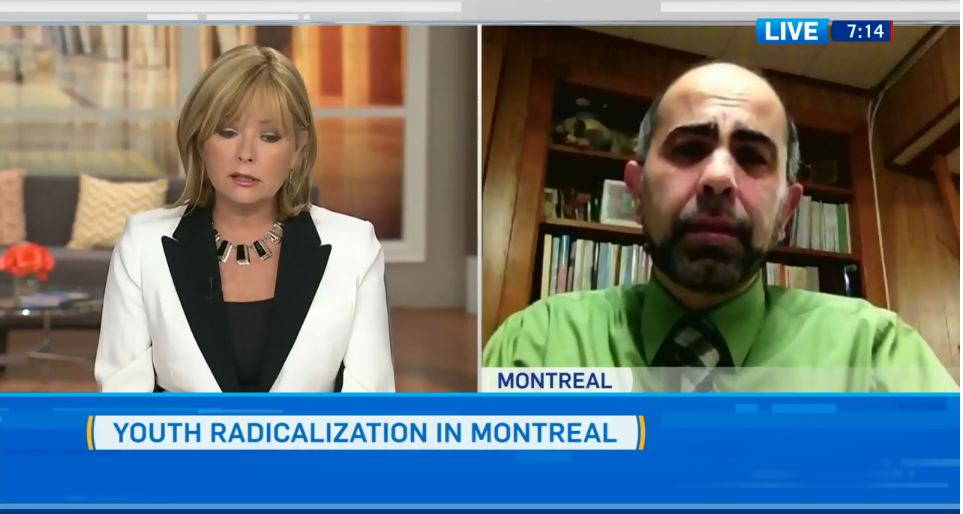
Radio interview :Samer Majzoub, president of the Canadian Muslim Forum, says legislators need to carefully consider the real-world, human rights implications.

CBC day break 12 june 2015

Radio interview :
On CBC daybreak, Montreal.

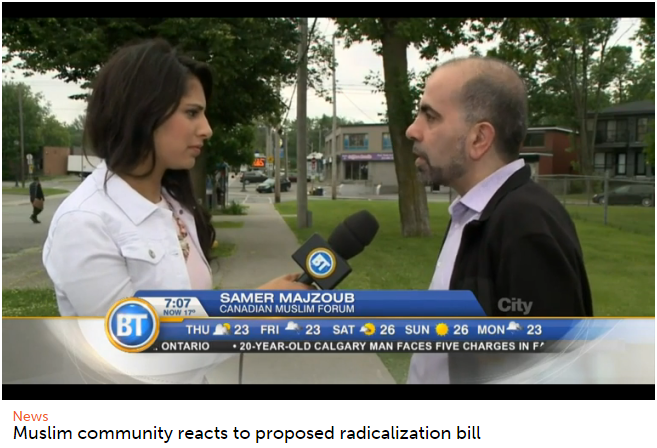
Muslim community reacts to proposed radicalization bill, Samer Majzoub of the Canadian Muslim Forum (FMC-CMF)

BT city TV June 12 2015

(FMC-CMF) Canadian Muslim Forum commenting this morning on proposed bills 59 and 62!

Samer Majzoub of the Canadian Muslim Forum talks to reporter Aalia Adam about how the Liberals’ proposed bills could lead to a rise in Islamophobia.

http://www.btmontreal.ca/videos/4290387627001/

Samer Majzoub of (FMC-CMF) Canadian Muslim Forum commenting on the neutrality, anti-radicalization anit-hate speech, bill 62 and bill 59. On CBC, June 10 2015


CBC June 10 2015 pic 1CBC June 10 2015 pic 2

(FMC-CMF) Canadian Muslim Forum commenting on the neutrality, anti-radicalization anit-hate speech, bill 62 and bill 59.
CMF comment at min 4:
http://www.cbc.ca/player/News/Canada/Montreal/ID/2669197411/

Article : Quebec Must Address its Growing Climate of Islamophobia by Samer Majzoub

مقابلة مع المتحدث الرسمي للمنتدى الاسلامي الكندي الاخت سماح الجباري مع راديو كندا الدولى في مونتريال

Muslim Quebecers have become victims of an increasingly dangerous Islamophobic environment. Recently, Quebec has witnessed very alarming anti-Muslim and anti-Islam rhetoric that has led to moral onslaught against citizens of Muslim faith. Such toxic atmosphere has been reflected in incidents of violence against Muslim Quebecers youth, women, men, community centers and mosques.

Since the establishment of the Commission on Reasonable Accommodation in 2007 followed by Bill 94 tabled by the PLQ in 2010, than bill 60 (charter of values) presented by the Parti Quebecois in 2013, the planned PLQ programs and measures to fight what is called “religious radicalism” in 2015 and finally the promised new charter of Quebec values to be presented by the provincial government during its current mandate ending in 2018. Running contenders from different political parties in addition to existing elected officials do not hide their intentions to join their peers in either introducing or supporting regulations that target Muslims’ culture under diffident labels and excuses.

The motto that secular Quebec is in opposition to all religious beliefs due to its history of social clash with the church is not quite correct in this context. While it’s an open highway for media outlets, politicians and others to offend, insult and attack the Muslim Quebec community by degrading its public figures, religious rituals, and tainting its institutions with shrouds of rumours, these smear and hatred campaigns are rarely targeting other citizens’ groups and cultures within the society. This fact brings the bitter reality that Muslim Quebecers have been under tremendous pressure with the evident lack of political will to stop the moral onslaught against noticeable segments of Quebec society.

The continuing violation of the basic human right to security and dignity has witnessed a surge in chauvinistic media campaigns against Quebec Muslims lately. Some media reports allege that the community’s schools and places of worship are related to “terrorist” organizations! By doing so, the level of prejudice against Muslim Quebecors has reached its peak in recent history in the province. Such rumours have crossed ethics and principles of honest media reporting putting children, pupils, employees and ordinary citizens at danger by associating them with institutions that are connected to alleged “fanatics”.

The exaggeration of incidents, twisting of facts and the discriminatory campaigns against any group of citizens due to their religious or ethnic background will lead to unhealthy social harmony within any society. In Quebec, Islamophobia, has become a strong trend that needs our attention as Quebecers from all stripes of the province’s elite, politicians, media, public figures and the general public to unite to defeat unfairness and racism. Quebec human rights values are great tools to fight all sorts of bigotry and intolerance. Islamophobia should have no place in Quebec.